

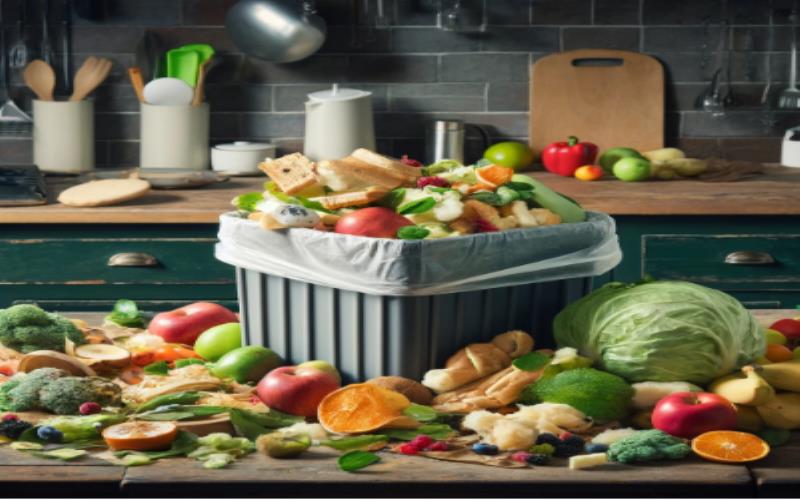
When food waste occurs in your garden, it is particularly painful. After all, you know exactly how much work and resources your home-grown fruit and vegetables have cost. This way, you avoid having to throw away your harvest.
We’ll show you a few tricks on how to prevent food waste in your garden right from the planning stage. You’ll also get ideas on how to save an overly large harvest from the garbage or compost heap.
There are many measures you can take to prevent food waste in the garden when planning your next gardening season.
The right varieties for the location: To prevent plants from dying, you should choose varieties that are suitable for the location and climatic conditions. For tomatoes and peppers, for example, it is sunny and warm, whereas cabbage and lettuce prefer partial shade. If you pay attention to the right site conditions, your plants will thrive better.
The right quantity: Think carefully about how many plants you need. You’ve probably heard of the famous “zucchini glut”. It’s amazing how many zucchinis a single plant can grow. Just two plants can feed a family of four. That’s why it’s better to plant a few less, even if the plants are very small, to begin with, and don’t look like they’ll be able to produce much. So you don’t need more than one or two zucchini plants.
EXTEND HARVEST SEASON
Tomatoes ripen later outdoors than in a greenhouse. One possible cause of food waste in the garden is that a lot of vegetables are harvested at once. You can prevent this by staggering the planting of vegetables:
Very fast-growing varieties in particular, such as lettuce, can easily be reseeded in small quantities every two to three weeks. This way, you will always have some fresh lettuce for many months, but never too much.
For other varieties, such as tomatoes, you can plant some in the greenhouse and some outdoors. The plants in the warm greenhouse will give you a harvest when it’s still too cold for them outside. At the same time, by the time the tomatoes outside ripen, you will have already harvested a lot in the greenhouse.
Avoid food waste in the garden: Share or swap with others
Your own harvest is a very tasty and environmentally friendly gift. To avoid food waste in the garden, you can simply share seeds, harvest and tips with others:
Many commercially available sachets contain far more seeds than you need. Although you can save most seeds for a few years and sow them later, their germination capacity decreases with each year. That’s why it’s better if you talk to friends and each buy just a few types of seed, which you can then divide up among yourselves. Look out for organic seeds and, ideally, seed-resistant seeds. You can then even use the latter to grow seeds of the same variety yourself.
When the plants are already growing, you can exchange growing tips with others. Perhaps someone has a great tip on how you can combat a disease organically and without synthetic pesticides. Or you can take turns watering so that nothing dries out when someone goes on vacation.
And when the fruit or vegetables are ripe, you can swap the harvest with others or give it as a gift. How about a full basket from your own garden as a birthday present, for example? This not only avoids food waste in the garden, but also packaging waste and gifts that are just lying around.
Tip: Mark fruit trees with yellow ribbons to let passers-by know that they can help themselves to them.
STORE AND RECYCLE
When processing and storing your harvest, you can avoid food waste from the garden in various ways:
It is a good idea to always process the whole plant or fruit if possible. For example, you can use vegetable peelings to make a healthy broth. You can find lots of ideas in our article on leaf-to-root.
Correct storage is crucial before processing. Perishable varieties can be preserved by cooking or fermenting. For example, you can preserve zucchinis or make your own sauerkraut. You can make delicious jams from fruit.
If, on the other hand, you have the problem that not everything has ripened despite good planning theeditorialge, there are recipes for green peppers, for example, and you can ripen tomatoes.
PRESERVING FOOD
Is your harvest so plentiful that you no longer know what to do with it? Here are some tips to prevent food waste:
Preserving zucchinis: 5 methods
Preserving tomatoes: These are the options
Preserving pumpkin: You can use these 5 methods
Preserving potatoes: How to preserve them
Preserving basil: 5 different ways to preserve it
Preserving plums: How to preserve the fruit
Preserving apples: Recipes and methods for preserving them
Preserving strawberries: 5 ways to preserve them
Preserving pears: How to preserve them quickly and easily for the winter
Preserving plums: Instructions and recipe
Preserving cherries: Simple recipe with and without sugar
